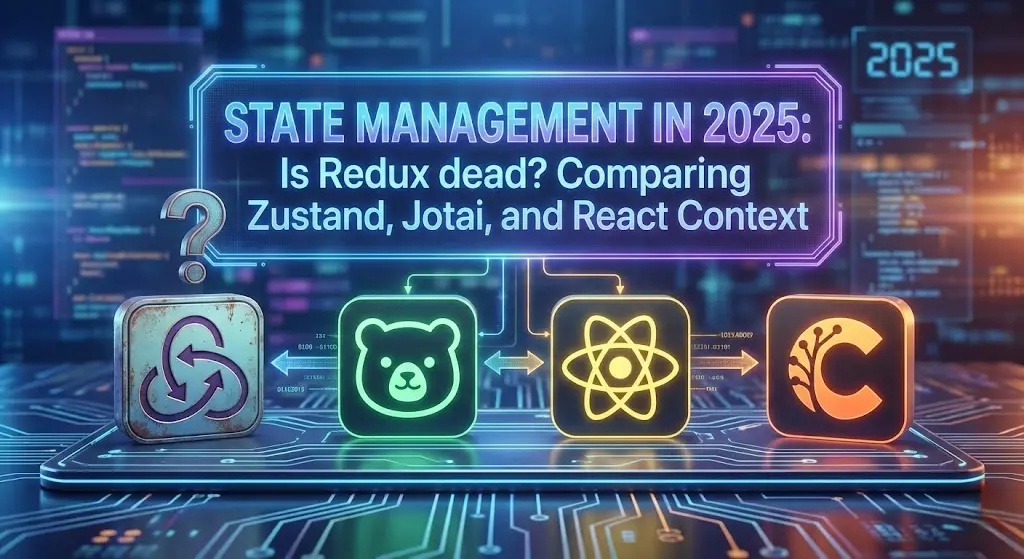
If you ask five React developers what state management library you should use, you’ll likely get six different answers. For years, Redux was the undisputed king. Then came the "Context is enough" movement. Now, in 2025, we are spoiled for choice with modern, lightweight libraries that challenge the old dogmas.
The question I hear most often is: "Is Redux dead?"
The short answer is no. But the long answer is that its role has shifted dramatically. It’s no longer the default for every project; it’s a specialized tool for specific problems. Meanwhile, challengers like Zustand and Jotai have risen to prominence, offering radically different mental models for handling data.
This guide will cut through the noise. We’ll compare the four major players—React Context, Redux (Toolkit), Zustand, and Jotai—and give you a clear decision framework for your next project.
React Context: The Built-in Solution (With a Catch)
Let’s start with what you already have. React Context is built-in, requires no installation, and is perfect for Dependency Injection.
The Use Case: Context shines for low-frequency updates that need to be accessed globally. Think:
- UI Themes (Dark/Light mode)
- User Authentication state (Logged in/out)
- Language/Localization settings
The Trap: Context is not a state management tool; it’s a transport mechanism. The biggest pitfall is using it for rapidly changing state. If you put your dashboard's real-time data into a Context provider at the top of your app, every component consuming that context will re-render whenever any part of that data changes.
This performance bottleneck is one of the common React mistakes that kills app speed. Unless you are incredibly careful with memoization, Context simply doesn't scale for complex state logic.
Redux in 2025: The Enterprise Workhorse 🏭
"Is Redux dead?" No. But the days of writing 50 lines of boilerplate for a simple counter are gone. Modern Redux, specifically Redux Toolkit (RTK), is a mature, powerful beast.
The Use Case: Redux is designed for complexity. It enforces a strict, unidirectional data flow that makes state changes predictable and traceable.
- Team Scale: When you have 20 developers working on the same codebase, Redux’s strict patterns prevent chaos.
- Debuggability: The Redux DevTools are still the gold standard. Being able to "time travel" and see exactly which action caused a bug is invaluable in large systems.
- RTK Query: This built-in data fetching tool is arguably better than the state management part itself, handling caching and polling effortlessly.
The Verdict: Use Redux if you are building a massive, long-lived application where maintainability and strict patterns are more important than initial setup speed.
Zustand: The Modern Default 🐻
If Redux is a semi-truck, Zustand is a sports car. It has become the de-facto recommendation for most new React applications in 2025.
The Philosophy: Zustand is unopinionated and simple. It creates a global store using hooks, without the need for a Provider wrapping your app.
import { create } from 'zustand';

const useStore = create((set) => ({
  count: 1,
  inc: () => set((state) => ({ count: state.count + 1 })),
}));

function Counter() {
  const { count, inc } = useStore();
  return <button onClick={inc}>{count}</button>;
}
Why Developers Love It:
- Tiny Bundle: It’s roughly 1kB.
- No Boilerplate: You define state and actions in one place.
- Performance: It solves the "Context Problem" out of the box. Components only re-render when the specific slice of state they select changes.
Zustand fits perfectly into the modern frontend stack because it gets out of your way and lets you build features.
Jotai: The Atomic Approach ⚛️
Jotai (and its predecessor Recoil) takes a fundamentally different approach. Instead of one giant store (top-down), you have many small, independent units of state called atoms (bottom-up).
The Use Case: Jotai excels in highly interactive, interconnected applications where state depends on other state. Think of things like:
- Dashboards & Canvas Apps: Where moving one shape might affect a calculation elsewhere.
- Spreadsheets: Where cell B3 depends on A1 and A2.
The Magic of Derived Atoms: You can create atoms that automatically calculate their value based on other atoms.
const priceAtom = atom(10);
const quantityAtom = atom(2);
// This atom updates automatically whenever price or quantity changes
const totalAtom = atom((get) => get(priceAtom) * get(quantityAtom));
Jotai handles the dependency graph for you. It’s conceptually similar to Javascript Signals, providing incredibly fine-grained updates. If you change the price, only the components displaying the total will re-render, leaving the rest of the app untouched.
The Decision Matrix: Which one should you choose?
Here is a simple framework to make your decision in 2025:
| Feature | React Context | Zustand | Jotai | Redux (RTK) |
|---|---|---|---|---|
| Best For | Static Global Data (Theme, Auth) | General Application State | Complex, Interdependent State | Enterprise, Massive Teams |
| Learning Curve | Low | Low | Medium | High |
| Boilerplate | Medium (Providers) | Very Low | Low | High |
| Performance | Poor for high-freq updates | Excellent | Excellent (Fine-grained) | Good (with tuning) |
| Mental Model | Prop Drilling Killer | Simple Store | Atomic/Signals | Flux Architecture |
Conclusion
Redux is not dead, but it has retired from being the default for every side project. In 2025, the landscape is about choosing the right tool for the complexity of your problem.
- Start with Zustand for 90% of your projects. It’s the sweet spot of power and simplicity.
- Use Jotai if you are building highly interactive, math-heavy UIs.
- Stick to Redux if you are in a large enterprise environment that values strict structure over speed.
- Keep using Context, but only for what it's good at: dependency injection and rare updates.
Understanding these trade-offs is part of the architectural mindset required to be a senior engineer. Don't just pick a library because it's trendy; pick it because it solves your specific bottleneck.