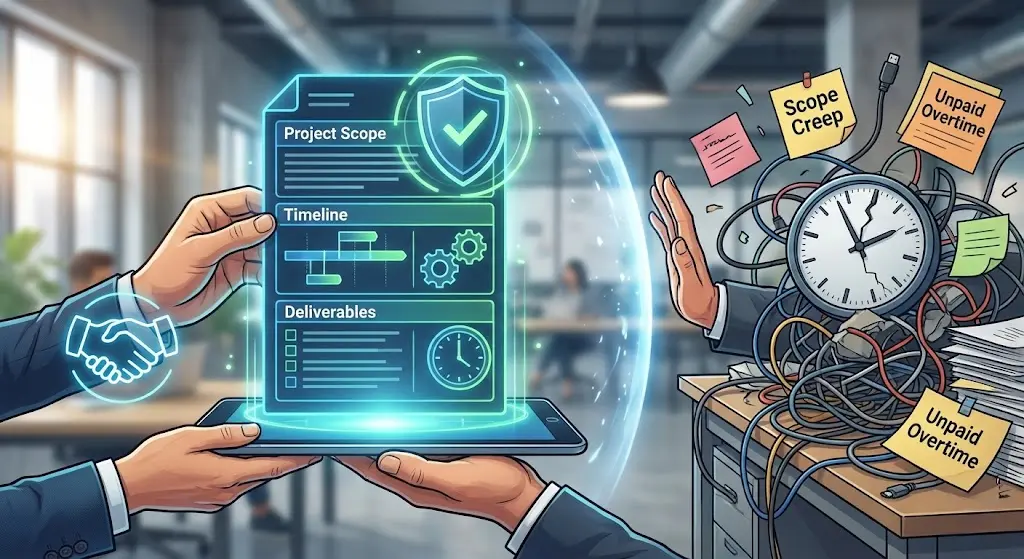
The difference between a freelancer who scrapes by and one who commands high rates often comes down to one document: the Technical Proposal.
Many developers treat proposals as an afterthought—a quick price quote sent via email. "I can build your React app for $5,000. It will take 2 weeks."
This approach fails for two reasons:
- It commoditizes your work. You are just another coder selling hours.
- It leaves you vulnerable. Without a defined scope, "build an app" can morph into a never-ending nightmare of feature requests.
A winning proposal is a sales tool, a project roadmap, and a legal shield all rolled into one. It demonstrates that you understand the client's business problem, not just the code required to fix it.
This guide will walk you through a proven structure for technical proposals that win clients and protect your sanity.
1. The Executive Summary: "I Understand You" 🤝
Do not start with "I will use Next.js." Start with them.
The first section should mirror the client's pain points back to them. If they told you they are losing sales because their site is slow, write that down.
Example: "Acme Corp is currently experiencing a 40% drop-off rate at checkout due to slow page loads and a confusing mobile interface. The goal of this project is to rebuild the checkout flow to reduce friction, improve load times to under 2 seconds, and ultimately increase conversion rates."
This instantly tells the client, "I am not just a coder; I am a consultant who cares about your business."
2. The Solution: "Here is the Plan" 🗺️
Now you can talk tech, but keep it focused on benefits. Instead of listing "React, Tailwind, Node.js," explain why you chose them.
- Architecture: "We will use a Headless WordPress architecture to give your marketing team the editing experience they love, while delivering a blazing-fast frontend to your customers."
- Performance: "We will prioritize optimizing Core Web Vitals to ensure high search rankings and a smooth user experience."
This frames your technical choices as business assets.
3. The Scope of Work: The "Yes" List ✅
This is the most critical section for protecting your time. Be excruciatingly detailed about what you will do.
- Frontend: Develop 5 responsive page templates (Home, About, Services, Blog, Contact).
- Backend: Implement custom post types for "Case Studies" using ACF and CPTs.
- Features: Integrate Stripe for payments and Mailchimp for newsletters.
If it's not on this list, it's not included in the price.
4. The "Out of Scope": The "No" List 🚫
Equally important is defining what you will not do. This prevents scope creep before it starts.
Out of Scope:
- Content creation (copywriting, photography).
- Logo design or branding.
- Ongoing SEO services or ad management.
- Data entry for more than 10 initial products.
When a client asks for "just one small thing" later, you can point to this section and say, "I'd love to help with that! Since it was listed as out of scope, I can send over a separate quote for that additional work."
5. Timeline and Milestones 🗓️
Break the project into phases. This builds trust and sets expectations.
- Phase 1 (Week 1-2): Design discovery and wireframing.
- Phase 2 (Week 3-5): Core development and API integration.
- Phase 3 (Week 6): QA, Automated Accessibility Testing, and bug fixes.
- Phase 4 (Week 7): Launch and training.
6. Pricing: The Investment 💰
Don't bury the price. Be clear and confident.
- Fixed Price: Best for well-defined projects. "Total Project Fee: $8,000."
- Milestone Payments: "50% deposit to start, 25% on beta delivery, 25% on launch."
Avoid hourly billing for large projects if possible; it penalizes you for being fast and efficient.
Conclusion
A great proposal isn't just about getting the job; it's about setting the stage for a successful project. By clearly defining the problem, the solution, and the boundaries, you position yourself as a professional partner rather than a subordinate.
Take the time to write a structured proposal. It will win you better clients, higher fees, and peace of mind.